/// NATIONAL VALUATION & AUDIT DESK · FIXED ASSET CONTROL & PHYSICAL AUDIT
Fixed Asset Physical Inventory, Industrial Tagging & IFRS / US GAAP Reconciliation in Colombia
Wall-to-wall physical asset auditing, industrial Metalphoto® anodized aluminum barcoding, DataMatrix and UHF RFID tagging. Line-by-line reconciliation against corporate ERPs (SAP S/4HANA, Oracle, Dynamics 365) and unassailable IAS 36 / ASC 360 impairment testing certified for Big Four auditors, statutory tax filings, and cross-border M&A.
High-durability Metalphoto® anodized aluminum plates, anti-metal UHF RFID tags, machine componentization under IAS 16, and zero-downtime physical scanning across continuous-production manufacturing plants, refineries, and distribution centers nationwide.
Big Four Audit Admissibility (IFRS / US GAAP / SOX 404)
99.8%
Variance Reconciliation Accuracy
32
Colombian Departments Covered On-Site
Proven Asset Auditing Rigor in Colombia · Over 20 Years of Institutional Practice (2006–2026)
Trusted by Multinationals, Financial Institutions & State Entities for Enterprise Asset Control
For two decades, Goods & Services Consulting S.A.S. has delivered institutional-grade fixed asset inventories, forensic ERP reconciliations, and IFRS/US GAAP valuations for Colombia's most demanding corporate groups and government authorities, including Empresa de Acueducto y Alcantarillado de Bogotá (EAAB), Grupo Energía Bogotá (GEB), Sociedad de Activos Especiales (SAE), Agencia Nacional de Infraestructura (ANI), INDUMIL, OPAIN S.A. (El Dorado International Airport), TransMilenio S.A., SATENA, IGAC, DANE, and global enterprises like Perficient and GateGroup.
20+ Years of Asset Auditing Rigor
Zero downtime on-site audits. Over 20 years executing complex wall-to-wall inventories across +500 industrial plants, logistics hubs, and corporate campuses in Colombia with zero production downtime.
Dual IFRS & US GAAP Compliance
Complete regulatory convergence across IAS 16 (Componentization), IAS 36 (Impairment), IFRS 13, and US GAAP ASC 360/820, satisfying the strictest PCAOB and SOX Section 404 internal control mandates.
Military-Grade Tagging Technology
Certified Metalphoto® anodized aluminum plates with sub-surface photographic imaging (25+ year lifespan, 450°C heat resistance, chemical immunity) and long-range anti-metal UHF RFID transponders.
Unassailable Tax & Statutory Defense
Technical pericial documentation justifying unrecorded retirements (bajas de activos) and depreciation expenses defense before DIAN (Arts. 128+ Estatuto Tributario), IRS, and Big Four review tables.
Do you require an institutional fixed asset audit or IFRS/ERP reconciliation?
Submit your project scope for immediate, confidential consultation via WhatsApp with a Senior Fixed Asset Architect at our national audit desk.
Direct partner desk · Bilingual practice (English / Spanish) · National desk: +57 (317) 639 4990 · Email: licitaciones@goodsyservices.com
The Corporate Fixed Asset Disconnect: Reconciling the General Ledger with Physical Reality
In complex corporate organizations, industrial conglomerates, and multinational subsidiaries operating across Colombia, the general ledger and the physical factory floor inevitably diverge. Unscheduled machine overhauls, cannibalization for replacement components, undocumented scrapping, unauthorized cross-facility transfers, and uncapitalized project expenditures create a widening chasm between accounting book balances and operational reality.
Empirical audit evidence indicates that un-audited corporate balance sheets carry an average of 15% to 30% "Ghost Assets" (Activos Fantasma)—items that remain on accounting registers being actively depreciated despite having been discarded, stolen, or destroyed years prior. Conversely, up to 10% to 20% of operational equipment discovered during on-site inspections consists of Unrecorded Found Assets (Activos Sobrantes), acquired through operating expense allocations, internal fabrications, or expired operating leases without formal asset capitalization.
This disconnect triggers severe financial, legal, and operational vulnerabilities: excess property taxes (Impuesto Predial) and inflated insurance premiums paid on non-existent machinery; statutory tax penalties from the Colombian Tax Authority (DIAN) under Article 647 of the Tax Statute for claiming fictitious depreciation deductions; and internal control material weaknesses under Sarbanes-Oxley (SOX) Section 404 that threaten Big Four audit opinions (PwC, EY, Deloitte, KPMG) for US SEC registrants and multinational parents.
Strategic Risk Mitigation: Eliminating ghost assets purges unnecessary risk premiums from corporate balance sheets, cleanses fiscal depreciation schedules before DIAN, and establishes an airtight chain of custody required for statutory compliance and cross-border M&A due diligence.
Elimination of Ghost Assets (Bajas de Activos): Rigorous physical verification identifies decommissioned assets, enabling legitimate write-offs that generate tax-deductible abandonment losses under DIAN Art. 128 ET.
Capitalization of Unrecorded Found Assets: RAA-certified appraisal under IFRS 13 / ASC 820 incorporates found operational assets at Depreciated Replacement Cost, bolstering corporate equity.
Insurance Premium Optimization: Realigning property, plant, and equipment declared values with physical existence curtails catastrophic multi-million peso overpayments on industrial all-risk insurance policies.
SOX Section 404 Compliance: Restores internal control over financial reporting, mitigating significant deficiencies and material weaknesses during external auditor testing.
100% Big Four Audit Admissible · Unassailable Tax Defense
/// RIGOROUS FIELD ENGINEERING · CERTIFIED END-TO-END EXECUTION
The 6-Phase Systematic 'Wall-to-Wall' Auditing Methodology
Executing an institutional fixed asset inventory across multi-site manufacturing complexes, logistics corridors, and high-security facilities demands engineering precision, operational discipline, and forensic accounting acumen. Goods & Services Consulting deploys a structured, military-grade 6-phase methodology designed to capture every physical asset without interrupting plant throughput.
Phase 1: Scope Definition, Taxonomy Harmonization & IFRS Classification: We audit the client's historical asset ledgers, define capitalization thresholds (e.g., assets > 50 UVT / USD $500), and configure a normalized technical taxonomy based on international standards (eCl@ss and UNSPSC). Asset classes are harmonized under IAS 16 Property, Plant and Equipment and corporate chart of accounts hierarchies.
Phase 2: On-Site Handheld Barcode & UHF RFID Data Capture: Our certified engineering teams mobilize to factories, refineries, warehouses, and offices equipped with IP67-rated rugged mobile terminals (Zebra TC57/MC3300) featuring integrated long-range 1D/2D optical imagers and UHF RFID sleds. Data collection occurs in full offline mode in remote locations, with secure cloud synchronization upon network restoration.
Phase 3: Standardized Industrial Tagging & Substrate Fastening: Affixing permanent physical tags tailored to asset environments: Metalphoto® anodized aluminum plates secured via 3M™ VHB™ structural adhesive or metallic blind rivets on heavy machinery; anti-metal UHF RFID transponders on mobile logistics assets; and tamper-evident VOID polyester labels on IT and executive gear.
Phase 4: High-Resolution Georeferenced Photographic Evidence & Nameplate Capture: Every single asset is documented with multiple high-definition digital photographs: overall equipment layout, exact tag placement, and macro shots of OEM nameplates capturing manufacturer, model number, serial number, electrical ratings (voltage, amperage, kW/HP), manufacture year, and physical condition indexing under the Ross-Heidecke engineering scale.
Phase 5: 1-to-1 Line-Item Accounting Reconciliation: Forensic cross-referencing between field data and historical ledger records using deterministic algorithms and forensic matching protocols, resolving bulk entries ("Batch of 50 pumps") into discrete asset master lines.
Phase 6: Pericial Valuation Report & IAS 36 / ASC 360 Impairment Package: Issuing the formal RAA-certified appraisal dictamen, remaining useful life schedules, residual salvage value determinations, and turnkey ERP migration upload files ready for direct posting.
Airtight Audit Trail: Every physical item is permanently bound to a digital fingerprint containing GPS coordinates, timestamped photographs, custodian e-signatures, and bilateral ERP keys, establishing an unbreachable chain of custody.
Centralized PMO Governance: Dedicated Project Management Office directing national logistical sweeps across Colombia's 32 departments simultaneously.
Industrial Rugged Scanners: Enterprise-grade optical and RFID mobile computers resistant to drops, dust, water (IP67), and hazardous environments.
Georeferenced Photo Repository: Complete digital evidence package providing external auditors instant visual verification of every asset.
Forensic Accounting Squads: Dedicated CPAs and NIIF specialists handling complex variance reconciliation and componentization.
A fixed asset inventory is only as durable as the physical media used to identify each asset. In past decades, enterprises suffered catastrophic failures by utilizing low-specification paper stickers, cheap plastic tags, or surface-printed labels that peeled, scratched, or dissolved under routine industrial maintenance. Goods & Services Consulting exclusively engineers and installs internationally certified identification substrates engineered to withstand Colombia's most aggressive operating environments.
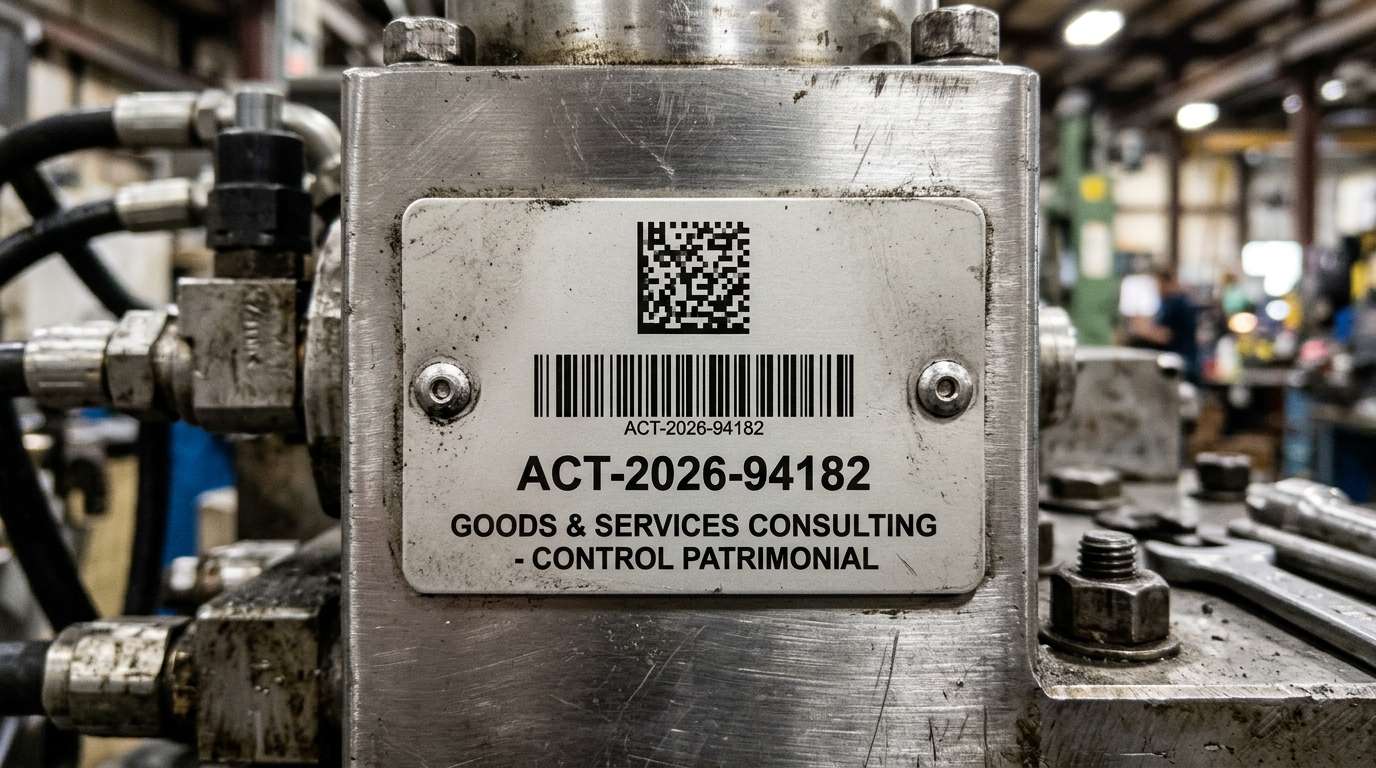
Metalphoto® Anodized Aluminum Plates (Military & Industrial Grade): The definitive specification for manufacturing plants, heavy machinery, power generation, and Oil & Gas infrastructure. Fabricated from high-purity aluminum alloy 1100 (0.5 mm to 0.8 mm thickness), barcode graphics, logos, and high-density DataMatrix codes are photographically embedded inside the sapphire-hard anodic layer (aluminum oxide) through chemical hydration and hydrothermal sealing. The image becomes an integral part of the metal, impervious to temperatures up to 450°C (842°F), prolonged solvent immersion (gasoline, jet fuel, diesel, hydraulic fluid, concentrated acids), intense UV radiation, and severe salt spray, guaranteeing legibility exceeding 25 years. Mounting is executed via ultra-high-shear 3M™ VHB™ structural adhesive or mechanical stainless steel blind rivets.
Passive UHF RFID Transponders (EPC Gen 2 / ISO 18000-6C): Operating in the 860–960 MHz frequency band, our on-metal encapsulated RFID tags incorporate specialized dielectric spacer materials (ferrite/ceramic) that eliminate electromagnetic interference from metallic machine bodies. These transponders enable instantaneous, bulk non-line-of-sight scanning at distances up to 6 meters, slashing annual verification cycles from weeks to hours.
Tamper-Evident Void Security Polyester (Corporate & IT Fleet): Engineered specifically for high-mobility laptops, data center servers, monitors, and executive furniture. Features an aggressive acrylic adhesive that bonds irreversibly to low-surface-energy engineering plastics (ABS, polycarbonate). Any peeling attempt fractures the substrate and leaves an indelible, permanent "VOID" checkered pattern on the equipment surface, eliminating internal fraud or tag substitution.
Laser-Etched 316 Marine-Grade Stainless Steel: Specified for chemical processing reactors, food and beverage sanitary CIP (Clean-In-Place) steam washdowns, and offshore marine platforms where harsh caustic caustic soda washdowns or extreme cryogenic temperatures exceed aluminum limits.
Optical & Digital Redundancy: All plates integrate dual-layer identification: human-readable alphanumeric text, 600 DPI laser/photographic 1D/2D barcodes (Code 128 / DataMatrix ECC 200), and optional UHF RFID microchips, ensuring instant readability by both basic smartphone cameras and industrial laser terminals.
Metalphoto® Anodized Aluminum: Certified to US Military Specifications MIL-STD-130N, MIL-A-8625F, and Federal Specification GG-P-455B.
Long-Range UHF RFID: EPCglobal Class 1 Gen 2 transponders enabling rapid mass auditing of high-density warehouse racks and machinery yards.
Tamper-Proof IT Security: Destructible VOID polyester labels preventing equipment swapping across remote and hybrid corporate workforces.
High-Performance Bonding: Industrial 3M™ VHB™ acrylic foam tape rated for dynamic mechanical stress, vibration, and thermal expansion cycles.
Collecting physical counts in the field represents exactly fifty percent of an institutional inventory project. The remaining fifty percent—where true strategic, fiscal, and balance sheet value is created—lies in the line-item forensic reconciliation against historical accounting ledgers. Corporate accounting databases rarely mirror the shop floor cleanly; they are encumbered by legacy bulk entries, historical mergers, unrecorded retirements, and unnotified site transfers.
Our multidisciplinary task forces—comprising forensic public accountants, systems engineers, and certified RAA appraisal specialists—execute an exhaustive 4-category reconciliation methodology designed to achieve 100% mathematical and evidentiary clearance:
1. Category A: Direct 1-to-1 Matched Assets: Physical equipment whose serial numbers, manufacturer nameplates, models, and specifications correspond directly to individual fixed asset subledger lines. We permanently bind the physical barcode/RFID plate number to the ERP asset master number and sub-number, updating cost centers, physical locations, and signed custodians.
2. Category B: Found Assets (Sobrantes / Unrecorded Additions): Highly productive machinery, vehicles, or IT infrastructure operating in facilities that possess zero accounting records in the fixed asset ledger (typically due to historical direct-to-expense purchasing, internal shop fabrication, donations, or expired operating leases). Under IAS 16 and IFRS 13 / ASC 820, entities cannot assign arbitrary values. Our RAA-certified appraisers perform an official valuation under the Depreciated Replacement Cost method (IGAC Resolution 941 of 2026), establishing fair value and remaining useful life. This pericial dictamen delivers the legal and accounting justification to debit PP&E and credit equity/retained earnings.
3. Category C: Ghost Assets (Faltantes / Unrecorded Retirements): Ledger records representing items that cannot be located following exhaustive multi-site sweeps and plant manager interviews. These represent machinery scrapped for parts, discarded due to irreversible technological obsolescence, or stolen. For every missing asset, our team compiles a formal Technical Pericial Write-Off Dossier (Dictamen Técnico de Bajas). This document establishes the technical cause of loss, giving corporate controllers and legal counsel the statutory foundation required by the DIAN under Articles 128, 129, and 140 of the Colombian Tax Statute to recognize tax-deductible abandonment losses without incurring penalties for fiscal inaccuracy under Article 647.
4. Category D: Custodian & Inter-Facility Divergences: Physical assets located in a different geographical department or branch than indicated on corporate ledgers (e.g., equipment registered in Bogotá but operating in Medellín or Barranquilla). We generate automated inter-company and inter-branch transfer matrices to restore perfect geographic transparency.
Defending the Balance Sheet Before External Auditors: Our partners personally attend audit defense review tables alongside corporate controllers, defending reconciliation assumptions, write-off thresholds, and capitalization entries before Big Four teams (Deloitte, PwC, EY, KPMG).
Bilateral Line-Item Matching: Granular resolution of historic aggregated entries ("Lot of 100 Motors") into individual asset sub-numbers.
RAA Certified Fair Value for Found Assets: Official pericial appraisal establishing auditable carrying values and remaining useful lives.
Statutory DIAN Write-Off Dossier: Comprehensive technical evidence package supporting tax deductions for scrapped and retired assets.
Automated Transfer Journal Entries: Ready-to-post accounting batches reallocating cost centers and responsible custodians across sites.
100% Big Four Audit Sign-Off · Full DIAN Tax Protection
/// ZERO-REWORK MIGRATION · ENTERPRISE SYSTEM HARMONIZATION
Seamless ERP Integration: SAP S/4HANA, Oracle & Microsoft Dynamics 365
A physical fixed asset audit reaches true operational completion only when the cleansed, reconciled master data is seamlessly loaded into the client’s Enterprise Resource Planning (ERP) platform. Delivering raw, unformatted spreadsheets dumps hundreds of hours of manual re-keying onto client IT and accounting teams, introducing extreme risks of database corruption, broken relational integrity, and delayed financial month-end closures.
Goods & Services Consulting eliminates this friction. Our database architects and systems engineers structure, validate, and deliver turnkey upload packages pre-formatted for direct mass ingestion into global and domestic tier-one ERPs:
SAP S/4HANA Migration Cockpit & ECC 6.0 (FI-AA & PM): Pre-validated mass migration templates mapping main numbers, sub-numbers, PM equipment links, cost centers, and depreciation keys.
Oracle Cloud Financials & Assets FBDI: Turnkey spreadsheets for the Mass Additions Interface with complete flexfield segment consistency and expense assignment.
Microsoft Dynamics 365 Finance & Operations: Turnkey data entity staging for the Data Management Framework (DMF), aligning Asset Groups, Books, and Dimensions.
Leading Regional ERPs (Siigo, Helisa, Novasoft, Infor, Epicor): Fully customized CSV/Excel batch interfaces adhering strictly to software import schemas.
Prior to client handover, all master files pass automated validation routines: purging hidden control characters (carriage returns, illegal quotes, non-UTF8 symbols), enforcing unique serial and barcode keys, and confirming active foreign key validation across cost center tables.
IAS 16 Componentization Without Rework:
For complex machinery comprising components with differentiated useful lives (e.g., turbines, heavy motors, pumps, and structural frames), we create component sub-asset numbers in the ERP to amortize each component according to its technical wear profile, eliminating financial disruption during future changeouts.
Asset control extends beyond static headcounts; it requires ongoing, legally defensible valuation modeling. Macroeconomic shifts, regulatory energy transitions, plant reconfigurations, and rapid technological advancements can render costly production machinery impaired on financial statements. Under both IFRS (IAS 36 Impairment of Assets) and US GAAP (ASC 360 Property, Plant and Equipment & ASC 820 Fair Value), corporate leadership must execute formal impairment tests whenever indicators arise.
Dual-Standard Impairment Testing Architecture: Goods & Services Consulting models and certifies the Recoverable Amount across individual machines or consolidated Cash-Generating Units (CGUs / Unidades Generadoras de Efectivo). Under IAS 36, the Recoverable Amount is determined as the higher of two rigorous financial metrics:
1. Fair Value Less Costs of Disposal (FVLCOD): Valued by our RAA-certified appraisers utilizing the Market Comparison Approach or the Depreciated Replacement Cost method under IGAC Resolution 941 of 2026, minus direct dismantling, brokerage, and freight expenses.
2. Value in Use (VIU / Valor en Uso): Calculated via comprehensive 10-year Discounted Cash Flow (DCF) models reflecting the entity’s continuing operational cash inflows, discounted at the pre-tax Weighted Average Cost of Capital (WACC) incorporating Colombia country risk premiums (EMBI+) and industry beta adjustments. For US SEC registrants, we execute the two-step recoverability test mandated by ASC 360.
The Cloud Asset Visualizer Repository: As part of our enterprise deliverables, clients receive dedicated access to our secure, cloud-hosted Asset Intelligence Platform. Executive teams, plant managers, and external Big Four audit teams can inspect the entire physical asset base digitally: 360° georeferenced high-resolution photos, scanned manufacturer nameplates, calibration certificates, Ross-Heidecke physical condition scores, remaining useful life projections, and interactive plant layout mapping across Bogotá, Medellín, Cali, and remote sites.
Big Four Transparency: Empower your external audit teams with direct, self-service digital access to photographic evidence and valuation workpapers, compressing audit testing timelines by over 60%.
Dual-Standard Impairment Reports: Certified impairment testing dossiers structured for IFRS IAS 36 and US GAAP ASC 360 compliance.
Econometric WACC & DCF Modeling: Rigorous calculation of pre-tax discount rates and multi-period discounted cash flows per CGU.
Cloud Digital Asset Repository: Encrypted, role-based cloud access to high-definition photographic records and equipment technical sheets.
PlatformEncrypted cloud database with high-resolution digital media and geolocations
Audit-Ready Workpapers · Full Life Cycle Asset Governance
/// INDUSTRIAL HARDWARE SELECTION GUIDE
Technical Specifications Comparison: Identification Media & Tag Substrates
Selecting the appropriate identification hardware is critical to ensure physical asset permanence, operational safety, and full compliance with international auditing standards. Review our engineering comparison of industrial tagging media deployed across corporate, manufacturing, and extreme environments.
Tag Technology / Material
Base Substrate
Attachment Method
Temperature Range
Chemical & Environmental Resistance
Estimated Lifespan
Typical Industrial Applications
Metalphoto® Anodized AluminumHeavy Industry Standard
High-purity Aluminum Alloy 1100 (0.5 mm – 0.8 mm thickness) with sub-surface photographic imaging
What is a physical fixed asset inventory, and why do Big Four auditors and statutory fiscal auditors require it under IFRS and US GAAP?
A physical fixed asset inventory is an exhaustive technical, engineering, and accounting audit procedure comprising the on-site physical sighting, unique identification, technical cataloging, operational status verification, and georeferencing of all Property, Plant and Equipment (PP&E) owned, leased, or controlled by an entity across its industrial plants, logistics hubs, and corporate offices.
Under International Financial Reporting Standards (IFRS: IAS 16, IAS 36, IFRS 13) and US GAAP (ASC 360, ASC 820, and SOX Section 404), external statutory auditors (including Big Four firms Deloitte, PwC, EY, and KPMG) mandate periodic physical audits to substantiate the core financial statement assertions: Existence, Completeness, Rights and Obligations, and Valuation.
Without verified physical counts, corporate balance sheets accumulate ghost assets (unrecorded retirements), distorting depreciation, violating statutory tax rules under DIAN Articles 128-140, and triggering qualified audit opinions or internal control material weakness disclosures.
What technical specifications distinguish Metalphoto® anodized aluminum tags, and why do standard adhesive labels fail in industrial environments?
Metalphoto® anodized aluminum plates represent the gold standard for heavy industrial machinery, electrical substations, boilers, and outdoor infrastructure. Fabricated from alloy 1100 aluminum (0.5 mm to 0.8 mm thickness), the barcode, DataMatrix ECC 200 symbol, and alphanumeric data are embedded photographically inside the sapphire-hard anodic layer of aluminum oxide, rather than printed on the surface.
This creates complete resistance to operating temperatures up to 450°C (842°F), direct exposure to hydraulic oils, diesel fuel, caustic cleaning solvents, sulfuric acid, and 25+ years of intense tropical UV radiation and maritime salt spray. Standard commercial polyester labels or surface-printed tags fail within 6 to 18 months in industrial environments due to adhesive degradation, mechanical abrasion, or chemical washdowns, resulting in complete loss of asset traceability and wasted investment.
How does the 1-to-1 line-item physical-to-accounting reconciliation work, and how are ghost assets and unrecorded additions resolved?
Reconciliation confronts every physically tagged asset against the historical general ledger and fixed asset subledger (SAP FI-AA, Oracle Assets, Microsoft Dynamics 365). Discrepancies are categorized into:
1. Matched Assets: Direct correlation linking new barcode/RFID tags to existing asset master numbers.
2. Physical Found Assets (Sobrantes): Operational assets present in plants but unrecorded in the ledger (expensed purchases, self-constructed assets, or expired leasing). These are appraised at IFRS 13 / ASC 820 Fair Value via Depreciated Replacement Cost by RAA-certified valuers and capitalized with formal audit justification.
3. Book-Only Ghost Assets (Faltantes): Items appearing in accounting but absent physically. We provide a Technical Pericial Write-Off Dossier (Dictamen Técnico de Bajas) documenting scrap, obsolescence, cannibalization, or theft, giving corporate tax directors and audit committees the unassailable statutory proof required under Colombian DIAN Articles 128+ and IRS regulations to claim tax-deductible abandonment losses.
How is the IAS 36 / ASC 360 impairment test performed on industrial machinery and Cash-Generating Units (CGUs)?
Under IAS 36 and US GAAP ASC 360, when triggering events occur (technological obsolescence, market shifts, production curtailments, or physical damage), entities must test whether the carrying amount of an asset or Cash-Generating Unit (CGU) exceeds its Recoverable Amount. The Recoverable Amount is the higher of Fair Value Less Costs of Disposal (FVLCOD) and Value in Use (VIU).
Goods & Services Consulting models FVLCOD through market comparison and Depreciated Replacement Cost under IGAC Resolution 941 of 2026, while calculating Value in Use through audited multi-period Discounted Cash Flow (DCF) models discounted at the company's pre-tax WACC. Under US GAAP ASC 360, we also execute the two-step recoverability test (undiscounted cash flows followed by fair value measurement). When impairment occurs, we structure the exact impairment loss allocation across asset classes for immediate board and auditor sign-off.
How are technical remaining useful lives and salvage (residual) values determined under IAS 16 Property, Plant and Equipment?
IAS 16 strictly prohibits the use of arbitrary statutory fiscal tax tables (e.g., rigid 10-year machinery or 20-year building rules) for financial reporting. Our engineering valuation teams evaluate technical durability factors in the field: operating duty cycles (single shift vs. continuous 24/7 high-stress operations), ambient environmental harshness (humidity, airborne particulates, corrosive vapors), historical maintenance regime (rigorous predictive vibration/thermography vs. run-to-failure reactive maintenance), and technological obsolescence (availability of OEM replacement parts and programmable logic controllers).
Residual (salvage) values are modeled based on secondary market salvage realities or net scrap metal weight (metric tons of steel/copper minus torch cutting and freight costs). This establishes an audit-defensible depreciable basis and annual depreciation schedule.
What is the financial, accounting, and tax treatment of fully depreciated assets that remain in active operation?
In Colombian and Latin American industrial plants, it is common to find heavy machinery, electrical infrastructure, and transport fleets that are 100% depreciated on accounting books (net book value of zero) but continue generating substantial productive output. Under IAS 16 paragraph 79(b), entities must disclose the gross carrying amount of fully depreciated PP&E still in use.
If migrating to the Revaluation Model, an independent RAA-certified appraisal under IGAC Resolution 941 of 2026 establishes the new Depreciated Replacement Cost (Fair Value) and re-estimates remaining useful life, crediting Revaluation Surplus in Other Comprehensive Income (OCI). For tax purposes in Colombia (Estatuto Tributario Articles 21-1 and 289), revaluation surpluses have no fiscal impact on corporate income tax, requiring a deferred tax liability calculation under IAS 12 and reconciliation in DIAN Form 2516.
How do you conduct nationwide wall-to-wall physical inventories across multiple facilities in Colombia without disrupting 24/7 industrial production?
Goods & Services Consulting employs a centralized PMO structure and multidisciplinary field engineering squads deployed nationwide across Bogotá, Medellín, Cali, Barranquilla, Cartagena, and remote mining/energy corridors. We operate around production schedules, deploying during scheduled shift changes, planned maintenance shutdowns, or executing non-intrusive scanning during active manufacturing.
Our engineers utilize IP67-rated rugged mobile terminals with integrated long-range optical scanners and UHF RFID sleds that operate 100% offline in remote or hazardous areas (ATEX / Class I Div 2 environments), synchronizing securely to our encrypted cloud master repository as soon as Wi-Fi or cellular connectivity is restored.
What internal controls (SOX 404 / COSO) must corporate entities establish to prevent theft and unauthorized transfer of IT and mobile assets?
Information technology assets (laptops, mobile workstations, telecom switches, and executive smartphones) present the highest vulnerability to shrinkage, employee retention upon departure, and unrecorded departmental relocations. To satisfy SOX Section 404 internal control mandates and COSO framework guidelines, we deliver:
1) Tamper-evident destructible VOID polyester security labels that fracture or leave irreversible adhesive footprints if removal is attempted;
2) Standard Operating Procedure (SOP) manuals governing asset handovers with digitally countersigned Custody Acceptance Acts;
3) Mandatory electronic transfer workflows before any physical movement between floors or branch offices; and
4) Cyclical rotational audit protocols recommending 10% monthly sample counts to ensure permanent master data accuracy.
How is the cleaned master asset data file structured for seamless bulk import into ERP systems like SAP S/4HANA FI-AA and Oracle Cloud ERP?
Our deliverable is never an unformatted spreadsheet; we configure and validate ready-to-import data structures tailored specifically to the client's ERP fixed asset module. For SAP ERP (ECC 6.0 and SAP S/4HANA FI-AA), we populate Migration Cockpit and LSMW batch input templates mapping Company Code (BUKRS), Asset Class (ANLKL), Main Asset Number (ANLN1), Component Sub-number (ANLN2 under IAS 16), Inventory Barcode Number (INVNR), Serial Number (SERNR), Cost Center (KOSTL), Plant (WERKS), and Depreciation Keys.
For Oracle Cloud Financials, we generate standard FBDI (File-Based Data Import) Mass Additions Interface spreadsheets. Prior to delivery, all records undergo automated syntax validation scripts to eliminate illegal characters, verify foreign key integrity, and enforce serial/barcode uniqueness.
Why does engaging an independent RAA-certified appraisal firm like Goods & Services Consulting guarantee unqualified audit sign-off from external auditors?
Under International Standards on Auditing (ISA / NIA 500 and 501), audit evidence gathered directly by an independent, objective external specialist carries substantially higher evidentiary weight than self-generated internal inventories. Internal staff often face conflicts of interest, lack specialized mobile scanning hardware, and lack formal engineering valuation credentials.
Goods & Services Consulting S.A.S. holds full corporate accreditation in the Colombian Open Registry of Appraisers (Registro Abierto de Avaluadores - RAA) under Law 1673 of 2013, with partners holding active designations in the Appraisal Institute (U.S.). Furthermore, our engagement includes active participation in Big Four audit review tables (PwC, EY, Deloitte, KPMG) to defend methodology, impairment models, and retirement write-off evidence until final sign-off is achieved.
/// FAST-TRACK INSTITUTIONAL AUDIT PROPOSAL
Commission a Certified Fixed Asset Inventory & Reconciliation
Whether preparing for an upcoming Big Four year-end audit, remediating SOX 404 internal control material weaknesses, or executing a complex ERP migration to SAP S/4HANA or Oracle Cloud, our senior asset architects provide prompt, confidential technical and commercial proposals.
100% Big Four Audit Admissibility GuaranteeOur methodology and reports comply with ISA 501, IAS 16, IAS 36, IFRS 13, and US GAAP ASC 360/820 standards.
24 to 48-Hour Technical Proposal TurnaroundReceive a detailed deployment schedule, personnel allocation matrix, and fixed-fee commercial proposal within 2 business days.
Turnkey ERP Ready-to-Import Data DeliveryPre-formatted batch upload templates for SAP S/4HANA (FI-AA/PM), Oracle FBDI, or Microsoft Dynamics 365.