Executive Summary
Santiago de Cali sits inside Colombia's High Seismic Hazard Zone (Zona de Amenaza Sísmica Alta), shaped by the Pacific subduction zone and the Romeral and Cali fault systems. Both commercial market value and mandatory condominium insurance under Law 675 of 2001 depend directly on NSR-10 structural compliance, local soil microzonation, and an accurate Replacement Cost New (RCN) appraisal that eliminates devastating underinsurance penalties.
1. Seismic Engineering & Cali Microzonation as Direct Market Value Drivers
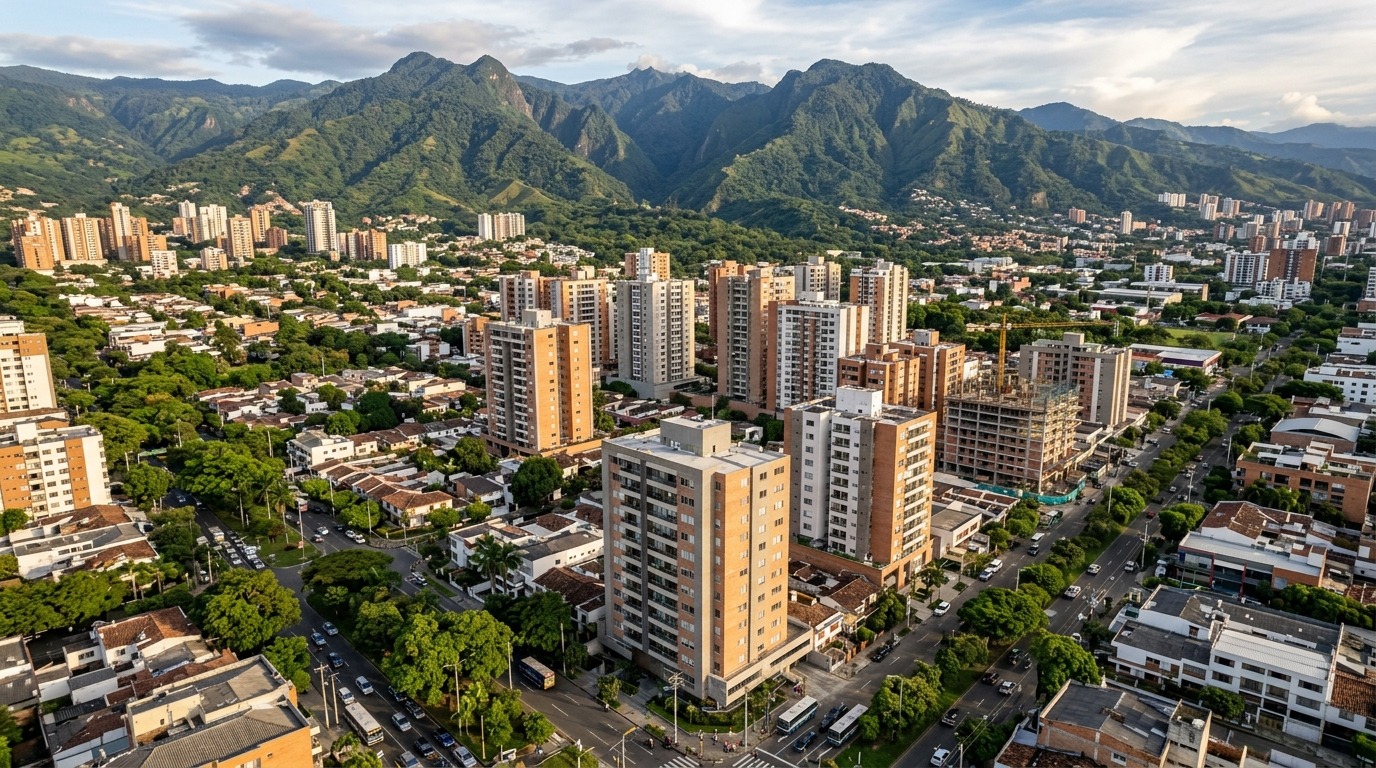
Real estate buyers, institutional lenders, and international insurers evaluate buildings in Cali with heightened structural rigor compared to low-seismic regions. Cali's official Seismic Microzonation Study divides the city into distinct geotechnical response zones—ranging from dense alluvial fans in western and central piedmont sectors to soft, compressible lacustrine and Cauca River flood-plain deposits in eastern and specific southern expansion sectors where deep pile foundations are mandatory. Buildings erected prior to Colombia's modern seismic codes (NSR-98 and especially NSR-10, enacted in 2010) often exhibit non-ductile concrete frames, soft-story ground-floor parking layouts, unreinforced masonry infill, or inadequate lateral bracing. During every physical inspection in Cali, our civil engineers identify structural vintage, foundation typology, differential settlement, facade cracking, and potential seismic-retrofitting capex—incorporating measurable functional-obsolescence adjustments into fair market value.
2. Mandatory Law 675 Common-Area Insurance & The Proportional-Rule Trap
Under Article 15 of Colombian Law 675 of 2001 (Horizontal Property Regime), every residential tower, gated condominium in Ciudad Jardín or Pance, medical center, shopping mall, and industrial park in Cali is legally required to maintain active Fire and Earthquake Insurance covering all common structures and installations at their true reconstruction value. However, many condominium boards mistakenly insure buildings using outdated municipal cadastral values or unadjusted historical construction costs from 10 to 15 years ago. Under Article 1089 of the Colombian Commercial Code, insuring a building below its current Replacement Cost New triggers the Proportional Rule (Regla Proporcional / Infraseguro):
- Illustrative Financial Impact: If a residential tower in El Peñón or Ciudad Jardín has a true 2026 reconstruction cost of COP 30 billion (including NSR-10 structural compliance, elevators, fire networks, and debris removal), but is insured for only COP 18 billion (60% of RCN), a partial earthquake or fire claim of COP 10 billion will be reduced proportionally by the insurer to just COP 6 billion minus the earthquake deductible—leaving homeowners facing a catastrophic special assessment and exposing the building administrator to personal civil liability.
- Separating Land from Insurable Structure: Land does not burn or collapse in an earthquake. Conversely, insuring the full commercial market value (which embeds land value) forces condominiums and industrial plants to overpay annual premiums unnecessarily.
3. Precision RCN Insurance Appraisals for Condominiums, Clinics & Plants
Our RAA engineers compute exact Insurable Replacement Cost New (RCN) schedules separating non-insurable land and deep foundations from insurable superstructure, electromechanical systems, elevators, substations, swimming pools, and debris-removal allowances—giving Cali HOA boards, industrial risk managers, and global insurance brokers ironclad coverage at optimal annual premiums.