With more than two decades of field engineering and appraisal leadership across Colombia's major producing basins, we safeguard the industrial capital of operators and institutional investors. Technical valuation reports prepared under IGAC Resolution 941 of 2026, API 650/653, ASME B31.4, Law 1274 of 2009, and IAS 37 ARO environmental provisions by certified Category 13 appraisers registered with the RAA (Law 1673 of 2013).


Trayectoria ininterrumpida desde 2006 tasando activos corporativos, industriales e infraestructura en todo el país.
Avaluadores con matrícula vigente en las 13 categorías del Registro Abierto de Avaluadores y personería A.N.A.
Membresía activa en el Appraisal Institute (EE. UU.). Dictámenes bilingües auditables bajo IFRS y US GAAP.
Admisibilidad plena ante toda la banca comercial colombiana, fondos de inversión inmobiliaria y tribunales judiciales.
The oil, natural gas, and mineral extraction industries in Colombia are critical pillars of foreign direct investment, national trade, and fiscal revenue. Capital-intensive assets across exploration, drilling, processing, transportation, and refining require certified valuations built upon rigorous engineering standards, legal enforceability, and international financial frameworks.
Industrial valuations in Colombia are strictly governed by Law 1673 of 2013 (Category 13: Specialized Assets of the National Appraisers Registry – RAA), IGAC Resolution 941 of 2026, International Valuation Standards (IVS), and IFRS / US GAAP standards (IAS 16 Property, Plant and Equipment, IAS 36 Impairment of Assets, and IAS 37 Provisions).
Every technical appraisal report carries legal public faith under Colombian law, ensuring total statutory admissibility before the Superintendency of Industry and Commerce (SIC), the National Tax Authority (DIAN), and the Council of State.
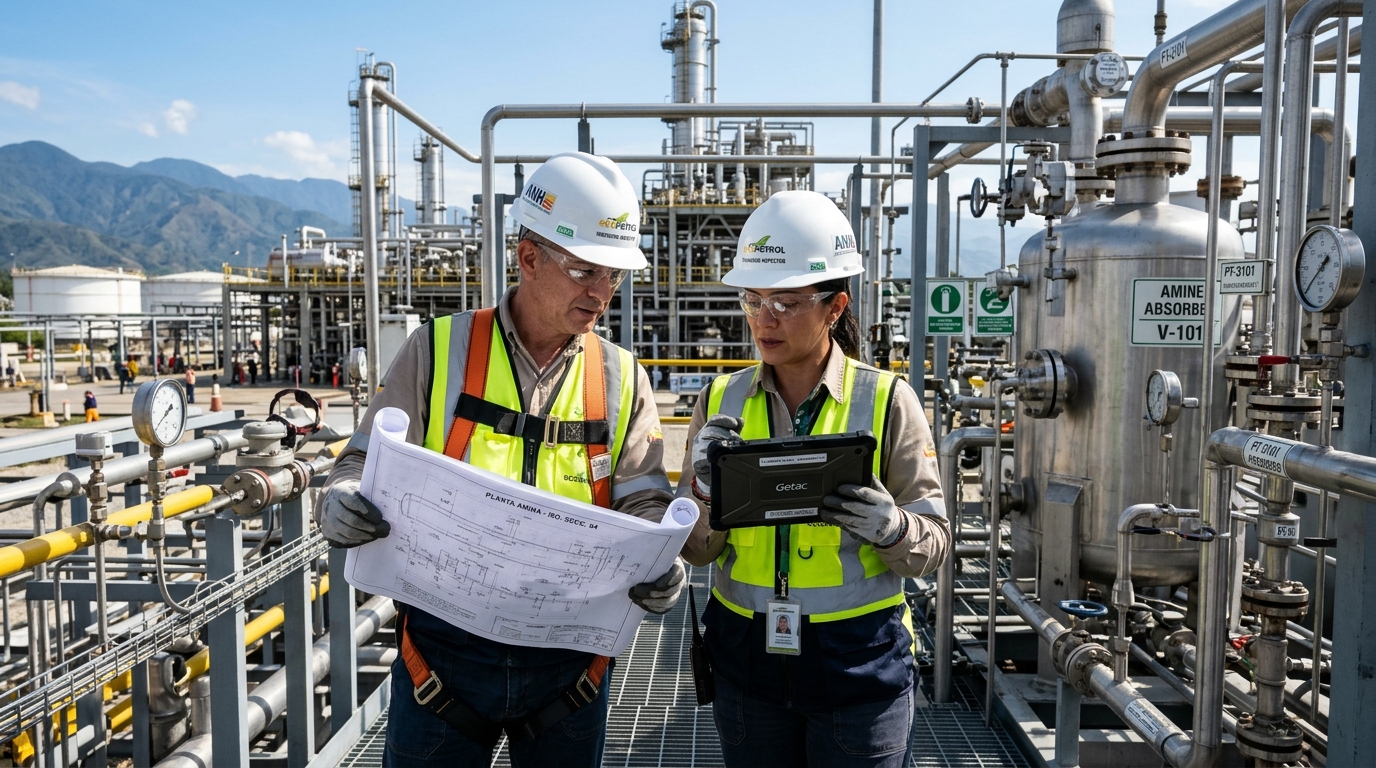
In upstream petroleum facilities, surface plant valuation cannot be separated from sub-surface reservoir life and the specific E&P concession agreement signed with the National Hydrocarbons Agency (ANH). Our certified appraisers incorporate Decline Curve Analysis (DCA) into technical depreciation schedules to accurately reflect economic asset value.
This holistic approach accounts for contractual reversions to the Colombian state and avoids arbitrary physical-only obsolescence calculations.
At Goods & Services Consulting S.A.S., our appraisal practice unites over 20 years of field inspections in Colombia's key petroleum basins (Llanos Orientales, Middle Magdalena Valley, Upper Magdalena, Putumayo, and Offshore Caribbean) with registered Category 13 petroleum, mechanical, electrical, and civil engineers.
Our certified opinions withstand rigorous forensic scrutiny by Big Four auditors (Deloitte, PwC, KPMG, EY) and administrative oversight bodies without qualification.
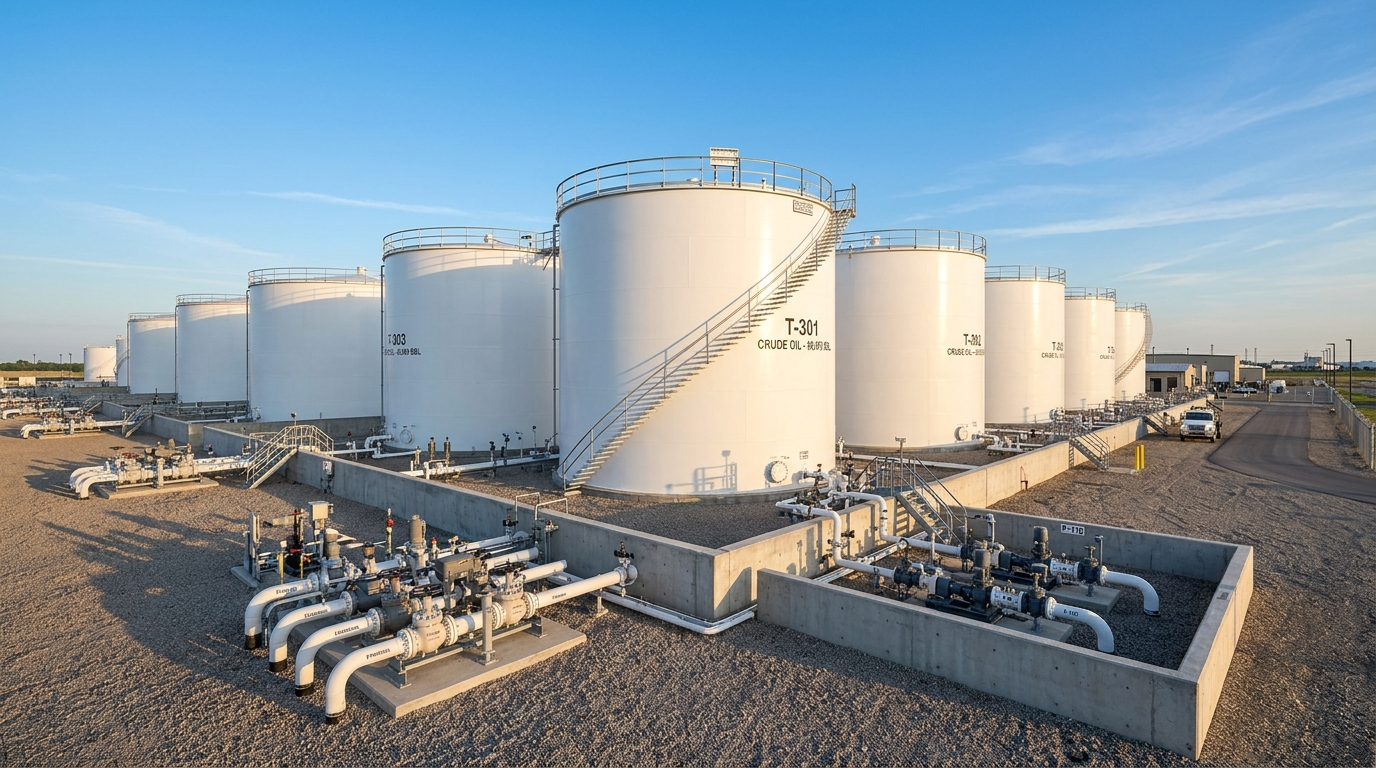
Storing stabilized crude oil, produced water, and refined fuels at export marine terminals and inland refineries requires carbon-steel welded atmospheric tanks constructed under API 650. The economic asset life and market value depend heavily on in-service mechanical integrity audited under API 653.
| Tank Component | Critical Wear Mechanism | Non-Destructive Testing (NDT) | Appraisal Value Impact |
|---|---|---|---|
| Bottom Plates | Under-bottom pitting & sulfate-reducing bacteria (SRB) | MFL (Magnetic Flux Leakage) & B-Scan UT | Determines remaining life or re-bottoming CAPEX |
| Shell Courses (1st & 2nd rings) | Hydrostatic head stress & cyclical fatigue | Ultrasonic thickness gauging (UT) | Governs allowable filling height and maximum capacity |
| Floating Roof & Rim Seals | Vapor loss & mechanical friction on seals | Visual rim inspection & seal gap surveys | Affects environmental compliance and hydrocarbon losses |
| Containment Bund Wall | Concrete spalling, liner degradation | Volumetric 110% NFPA 30 containment check | Directly impacts environmental contingent liability risk |
Our appraisers review API 653 historical inspection records, strapping calibration tables (certified volume tables under API MPMS Chapter 2), and non-destructive examination (NDE) data. We verify remaining corrosion allowance on shell courses, bottom plate thickness via Magnetic Flux Leakage (MFL), and foundation annular ring settlement.
Severe bottom plate thinning or out-of-round shell deformation requires substantial repair allowances, directly impacting the fair market value through technical physical obsolescence deductions.
Evaluation covers internal and external floating roof primary and secondary rim seals (mechanical shoe or liquid-mounted), rolling ladders, roof drainage systems, and cathodic protection systems (impressed current or sacrificial anode).
We also assess secondary containment dikes (berms), impervious membrane liners, foam fire suppression systems (NFPA 11), and deluge cooling spray rings required by local environmental regulations and insurance underwriters.
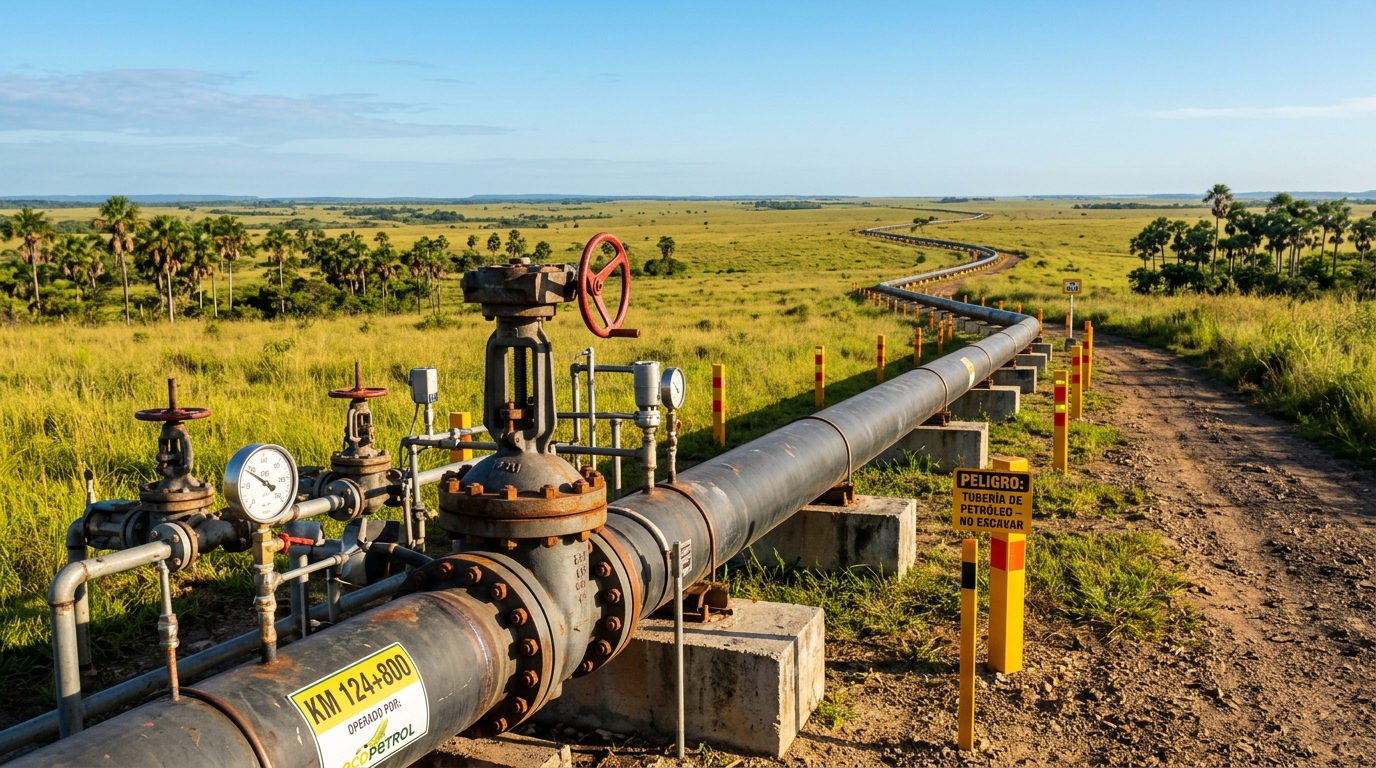
Transporting heavy crude oil, refined fuels, and natural gas across Colombia's formidable Andean geography, wide alluvial river valleys, and floodplains turns pipelines into high-complexity appraisal assets. Valuations are conducted under ASME B31.4 (Pipeline Transportation Systems for Liquids) and ASME B31.8 (Gas Transmission and Distribution Systems).
The physical pipeline asset is assessed by analyzing line pipe specification conforming to API 5L (grades X52 to X70), nominal wall thickness, multi-layer coating (FBE, 3LPE), Horizontal Directional Drilling (HDD) crossings beneath major rivers (Magdalena, Meta, Cauca), aerial suspension bridges, block valve stations with automated shutdown valves (SDV), pig launchers/receivers, and Impressed Current Cathodic Protection (ICCP) systems complying with NACE SP0169.
We analyze intelligent smart pig data (Magnetic Flux Leakage - MFL for metal loss, EMAT for stress corrosion cracking, and caliper tools for geometric dents), verifying whether operating pressures require MAOP derating or planned pipeline repair sleeves under ASME B31G / RSTRENG calculations.
We value all associated surface installations along the transport corridor: mainline pumping stations driven by gas turbines or heavy diesel engines, gas compressor packages, intermediate block valve stations, and fiscal custody transfer metering skids (API MPMS).
Furthermore, we audit active geological fault crossings, landslide mitigation works (gabions, horizontal drains, tieback anchors), and river scour protection structures.
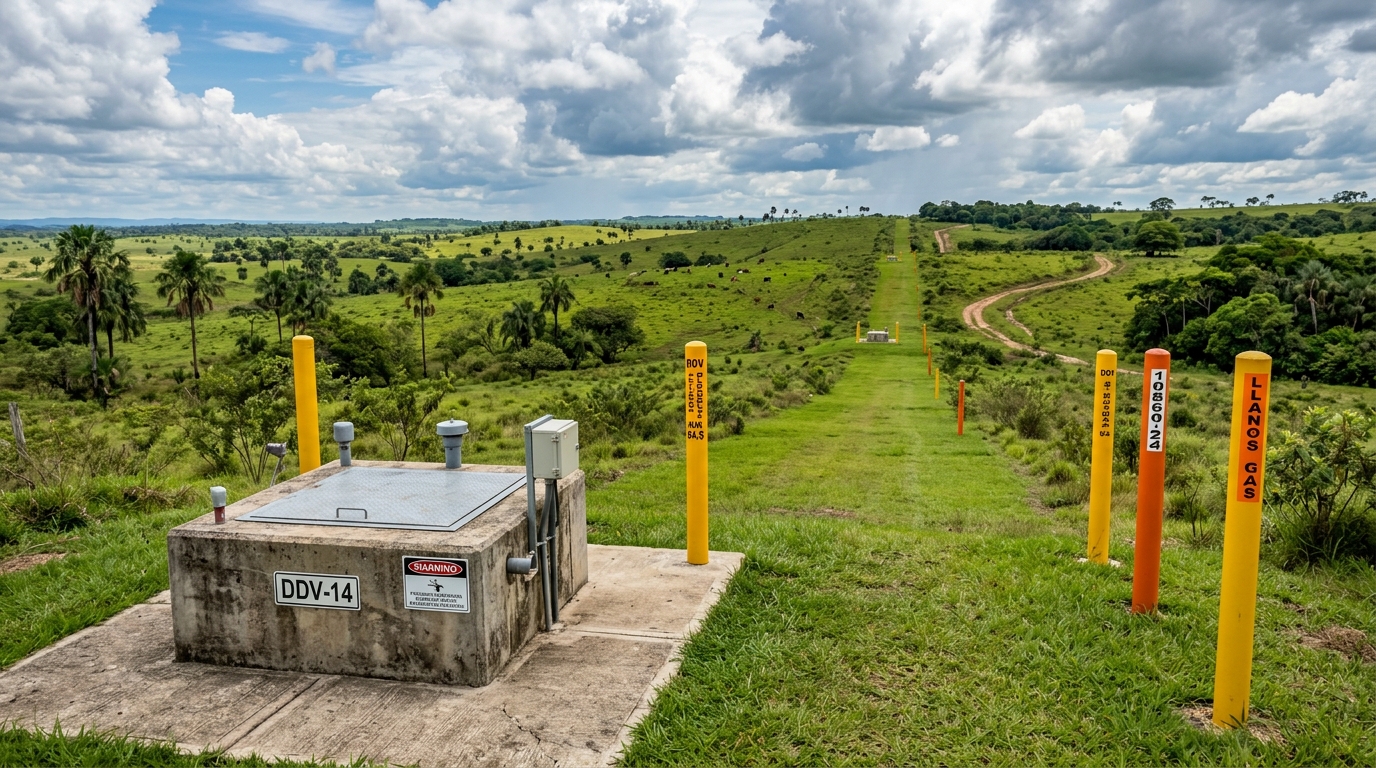
Constructing flowlines, access roads, well pads, transmission lines, and pipelines across private ranches or public lands requires the establishment of statutory petroleum easements governed by Law 1274 of 2009 and Decree 1073 of 2015.
Establishing compensation under Law 1274 of 2009 requires a rigorous technical and legal breakdown of three distinct statutory components:
• Land Use Indemnification (Indemnización por Uso): Commercial market value of land within the permanent right-of-way (DDV) and temporary work areas, determined via comparative market sales under IGAC Resolution 941 of 2026 adjusted by land-use restriction coefficients.
• Actual Damages (Daño Emergente): Valuation of fences, timber, permanent crops, drainage channels, irrigation systems, and structures directly damaged during construction.
• Loss of Agricultural & Livestock Profits (Lucro Cesante): Discounted cash flow calculation of net agricultural or cattle earnings lost due to diminished livestock carrying capacity (Livestock Units/ha) or interrupted crop cycles (oil palm, rice, cacao, citrus).
Our expert appraisal reports meet all procedural requirements under the General Code of Process (CGP, Arts. 226-228), providing solid legal backing during direct operator-landowner negotiations (20-day statutory term) and before civil judges granting provisional land handover (entrega provisional).
We incorporate georeferenced cadastral boundaries (IGAC standards), soil classification studies, and prevailing market transactions to defend oil & gas operators against abusive claims while ensuring fair compensation for landowners.
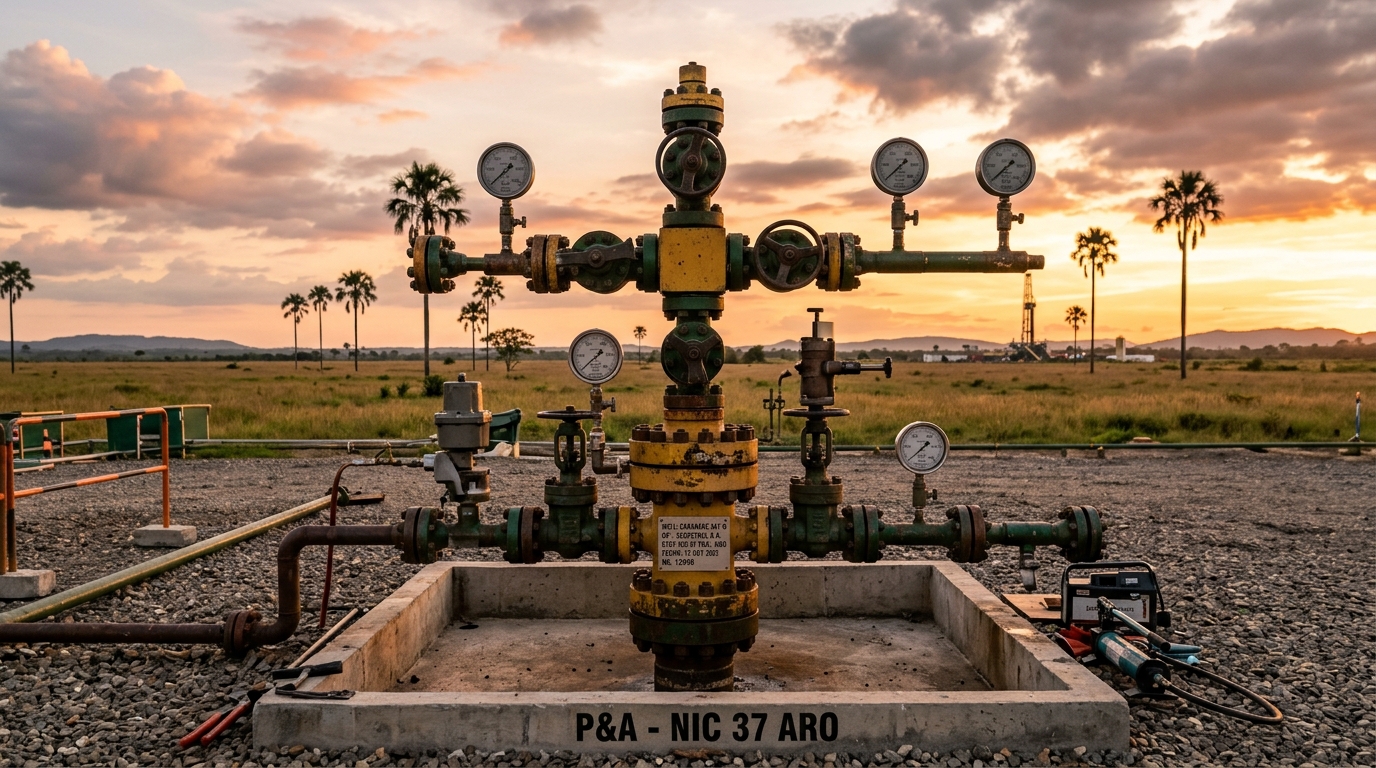
Acquiring upstream concessions and environmental licenses in Colombia brings statutory obligations to plug depleted wells, dismantle surface batteries, and restore biological habitats upon field depletion. Under IAS 37 (Provisions, Contingent Liabilities and Contingent Assets) and US GAAP ASC 410, operating companies must record the discounted present value of these Asset Retirement Obligations (ARO).
Cost modeling covers rig spread daily rates (workover or snubbing units), cement bond logs (CBL-VDL) to verify annular seal integrity, setting balanced Class G cement plugs (API Spec 10A) across producing horizons and freshwater aquifers, mechanical casing cutting below ground level (minimum 2 meters below cellar floor), and welding identification marker caps with official georeferenced coordinates.
Engineering estimates account for well depth, borehole deviations, high-pressure/high-temperature (HPHT) conditions, and mechanical well integrity issues (corroded casing or sustained casing pressure).
We estimate complete decommissioning costs for surface processing plants: chemical decontamination and degassing of pressure vessels and flowlines, cold cutting and rigging of structural steel, demolition of reinforced concrete equipment pads and containment bunds, and disposal of hazardous waste and salvageable scrap metals.
Offsite salvage value of reusable equipment is netted against dismantling expenditures according to IFRS guidelines.
Restoration modeling includes in-situ and ex-situ bioremediation of hydrocarbon-contaminated soils to meet regulatory Total Petroleum Hydrocarbons (TPH) limits, biological bio-piles, civil earthmoving to restore natural terrain contours, and reforestation using native flora approved by ANLA and regional environmental authorities.
Our ARO valuation packages include transparent engineering cost build-ups and inflation/discount rate models that facilitate seamless audit clearance by Deloitte, PwC, KPMG, and EY without audit qualifications.
Our valuation practice synthesizes four recognized international methodologies under IVS and IGAC standards to triangulate dependable asset values.
Estimates current Gross Replacement Cost of new modern equivalent assets, deducting physical obsolescence (Ross-Heidecke model), functional inefficiencies, and economic curability.
Projects net future cash flows generated by operating assets, discounted by the Weighted Average Cost of Capital (WACC) to derive present commercial value for going-concern facilities.
Benchmarks mobile assets (drilling rigs, mining fleets, support vessels) against verified transactions and auction sales from global specialized databases (RigZone, Ritchie Bros, Infomine).
Parametric engineering modeling of plugging, dismantling, and bioremediation expenditures, discounted to present value through risk-adjusted sovereign yield curves.
Answers to critical legal, accounting, and technical inquiries regarding industrial valuations in Colombia.
Under Law 1673 of 2013, appraisals of hydrocarbons and mining infrastructure require registered appraisers in Category 13: Specialized Assets (Activos Especiales y Complejos Industriales), frequently combined with Category 5 (Industrial Machinery and Equipment) and Category 6 (Specialized Civil Works). Goods & Services Consulting has certified senior engineers in all relevant categories.
IGAC Resolution 941 of 2026 regulates official valuation procedures across Colombia, establishing mandatory standards for sample homogeneity, statistical variance limits, component depreciation schedules, and georeferenced spatial verification. Our reports strictly incorporate these statutory parameters to guarantee unassailable legal validity.
Yes. Our appraisals adhere to International Valuation Standards (IVS) and the standards of the Appraisal Institute (USPAP). Reports are routinely accepted by tier-one Colombian commercial banks (Bancolombia, Banco de Bogotá, Davivienda) as well as international syndicates, IFC, and multilateral development banks for reserve-based lending (RBL) and asset-based loans.
Law 1274 establishes an initial 20 continuous calendar-day term for direct negotiation between the petroleum operator and the landowner. Having a certified RAA valuation report during this direct window is crucial to establish a realistic baseline and, if agreement is not reached, to expedite the judicial process for provisional land handover before civil courts.
Big Four auditors (PwC, EY, Deloitte, KPMG) require transparent, itemized engineering models detailing well plugging spread rates, chemical decontamination, surface demolition quantities, and bioremediation unit costs, discounted with risk-free government curves. Our technical reports provide complete audit trails and sensitivity analysis models, ensuring rapid audit clearance.
Typically: asset fixed registers (SAP/Oracle), Process Flow Diagrams (PFD), Piping & Instrumentation Diagrams (P&ID), plot plans, API 653 / API 510 historical inspection dossiers, smart pigging ILI reports, environmental management plans (PMA approved by ANLA), and the applicable ANH concession contract details. We sign formal mutual NDAs prior to receiving confidential technical records.
Request a formal technical and commercial valuation proposal in under 2 business hours. Our certified senior appraisers will contact your leadership team to define scope, on-site field visits, and delivery milestones.